
A Professor’s POV: Why did the United States go to war with Spain?
For a good web site on the Spanish American War click here.
Industrialism had changed the United States. Americans began to view their nation with increasing nationalism. The spirit if expansion and imperialism was fueled by these feelings. For one hundred years America had taken a back seat to the traditional European powers, that many American felt, should change.
In order for America to take its rightful place amongst the worlds power many felt we needed to control a vast imperial empire. This empire would provide a market for our goods, raw materials for our factories and protection for our commercial interests. The expansion was, as previously discussed, justified by the need for our people to expand commercially and the social Darwinist idea of the white man’s burden. With this need in mind eyes turned towards Spain. Spain, a once mighty empire, still with vast colonial holdings many of them in our Caribbean backyard, was now a much weaker nation than us. They were ripe for the picking and a their imperial holdings would be the spoils of victory.
I. The Spanish American War
A. What caused an increase in tension between the United States and Spain?
1. In 1895 civil war broke out in Cuba between Spain and the Cubans.
2. The conflict was described by Senator Redfield Proctor of Vermont as bloody and brutal.
3. Newspapers (particularly those owned by William Randolph Hearst) reported the brutality of the Spanish General Weyler in graphic and often biased terms. The New York Journal reports “…blood on the roadsides, blood in the villages, blood, blood, blood!” American newspapers were clearly pushing the nation towards intervention in the Cuban situation.

This drawing shows Uncle Sam angrily raising the flag towards the star that says “Free Cuba.” Underneath his outstretched hand is the sinking USS Maine and on the desk, under a sword, is a Joint Resolution of Congress. Guess what it would be a resolution for… WAR!
This original drawing expresses the angry end of restraint on the part of U.S. authorities and the public at the war’s outbreak.
Once again, the two dominant causes for war intervention are depicted as Cuban freedom and the destruction of the Maine. C. G. Bush was the influential and bellicose star cartoonist of The World, which sometimes published his editorial cartoons on the front page.
4. American Presidents Grover Cleveland and his successor William
McKinley opposed the intervention but a series of events would push
us over the edge.
B. What event pushed the United States into war with Spain?
1. The DeLome Letter – A letter by Spanish Ambassador to the United States Enrique DeLome was intercepted by Hearst’s newspaper and published on the front page. The DeLome letter called President McKinley “…weak and a bidder for the affections of the people…a would be politician who leaves a door open behind himself while at the same time trying to appease the jingoes of his party.” (The term “jingo” comes from a term used at the term of the century to describe one who was intensely nationalistic and often militaristic.) The DeLome letter embarrassed McKinley and brought us one step closer to war.
2. The Sinking of the Maine – As tensions had increased the United
States has sent it’s fleet to Cuba to protect American economic
interests.
The Maine in Havana Harbor three weeks before it was
sunk.
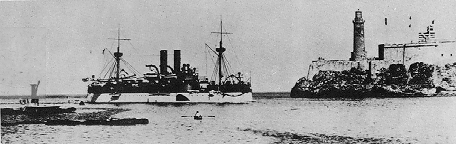
On the night of February 15, 1898, the ship was sunk by a tremendous explosion, and 260 lives were lost. Reports pointed to sabotage, but responsibility for the disaster was not determined. The New York Journal reported that a Spanish Mine had had sunk the Maine. Other newspapers showed pictures of Spanish terrorists swimming under
the Maine and placing explosives under the ship.
headlines published by the New York Journal
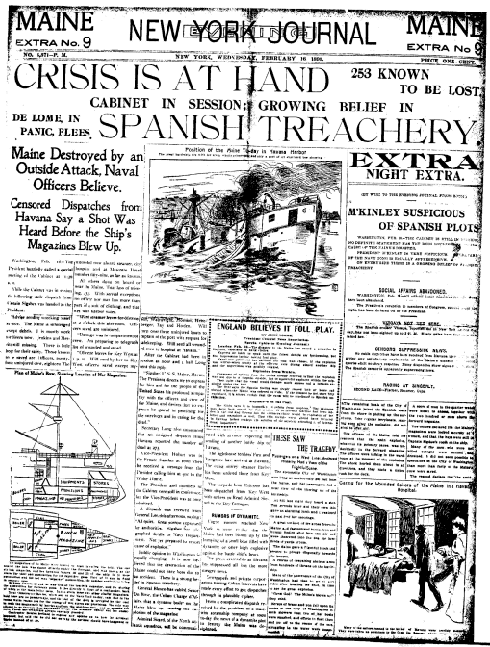
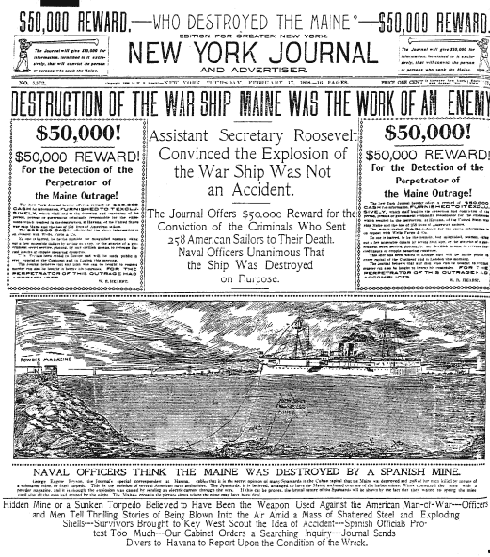
Publisher William Randolph Hearst had instructed hie photographers: “You furnish the pictures…I’ll furnish the war!” Looking at these headlines it is obvious that Hearst, and his competitor Pulitzer, published information that they could not back up. This influenced Americans to push for war with Spain. This biased and irresponsible reporting is known a yellow journalism. It is clear that the so called “yellow press” was deeply involved in pushing the US into war.
3. On April 20 President McKinley approved a congressional resolution that called for immediate Spanish withdrawal from Cuba, and on April 24 war was declared by the Spanish government. On April 25 the U.S. Congress declared that hostilities had officially begun on April 21. Congressional resolutions affirmed Cuban independence and stated that the United States was not acting to secure an empire. Clearly this was not the case but the justification was neccessaary.
C. How did America win the Spanish-American War?
1. The war was fought in the Spanish colonies of the Philippines and Cuba. On June 22, 1898, the United States landed 15,000 soldiers southeast of Santiago de Cuba. The troops engaged and defeated Spanish land forces July 1 around the city. The most famous engagement was Lieutenant Colonel Theodore Roosevelt’s charge up Kettle Hill during the Battle of San Juan Hill. Meanwhile, U.S. naval forces blockaded the harbor of Santiago de Cuba. Spanish ships tried to run the blockade as soon as the land engagements had begun, but pursuing American naval vessels sank or forced the fleeing ships aground. No serious damage occurred to any U.S. ships.
2. This newspaper shows America’s triumph…yet another example of
Yellow Journalism.

The World’s front page announcing US victory in the Philippines.
Frequently Asked Questions
1. What was the primary reason the United States became involved in the Spanish American War?
The primary reason for the United States' involvement in the Spanish American War was the explosion of the USS Maine in Havana Harbor on February 15, 1898. The mysterious sinking of this battleship led to the loss of 266 American sailors. While the exact cause of the explosion was unknown—and remains debated even today—U.S. newspapers stirred public opinion by blaming Spain shortly after the incident, leading to a significant outcry for military action. This event served as a catalyst, adding to the pre-existing tensions between the United States and Spain over the Cuban struggle for independence from Spanish rule. The U.S. government, under President William McKinley, cited the need to protect American citizens and their interests in Cuba and to end the oppressive Spanish regime in the Americas, which further justified their decision to go to war.
2. How did economic interests influence the U.S. decision to engage in conflict with Spain?
Economic interests played a crucial role in motivating the U.S. engagement in the Spanish American War. At the time, the United States had invested heavily in Cuba's sugar industry. The ongoing Cuban War of Independence had disrupted trade and posed a threat to U.S. investments. American businessmen and politicians feared the loss of economic opportunities and the potential impact on the economy. Additionally, the Strategic acquisition of new territories like Puerto Rico, Guam, and the Philippines was seen as a way to open new markets for American goods and expand the nation’s influence. In a period marked by the expansionist sentiment embodied in the idea of Manifest Destiny, the war was viewed as an opportunity to extend America’s reach and secure its economic future.
3. What role did the concept of Manifest Destiny play in the U.S. entering the war with Spain?
The concept of Manifest Destiny—a widely held belief in the 19th-century that American expansion was both justified and inevitable—was instrumental in the U.S. decision to go to war with Spain. Since its formulation, Manifest Destiny had driven U.S. policy to expand westward across the North American continent. By the late 1800s, with the continental expansion completed, the United States turned its attention overseas. The Spanish American War offered an opportunity to extend American influence and control beyond the continental borders. Territories like Cuba, Puerto Rico, Guam, and the Philippines were seen not only as strategic naval and military outposts but also as the fulfillment of America’s divine mission to spread democracy and civilization. This overarching ideology made the public and policymakers more receptive to imperialistic ventures, including military conflict with Spain.
4. How did the media and public opinion contribute to the U.S. decision to declare war on Spain?
The media played an influential role in shaping public opinion and pushing the United States toward war. Known as "yellow journalism," this style of sensationalist reporting exaggerated or fabricated news to sway readers. Publishers like William Randolph Hearst and Joseph Pulitzer engaged in fierce competition, often prioritizing dramatic stories of Spanish atrocities in Cuba, which heightened tensions and enflamed American sentiment against Spain. Catchy headlines and lurid tales of Spanish brutality appealed to the American public's emotions, creating a fervent climate that pressured policymakers to act. This media-driven hysteria turned the sinking of the USS Maine into a national call to arms, effectively maneuvering the U.S. closer to declaring war on Spain.
5. What strategic interests did the U.S. have in the Pacific region, and how did that relate to the war with Spain?
The U.S. strategic interests in the Pacific were a crucial factor in its pursuit of war with Spain. The United States was keen on establishing itself as a dominant power in the Pacific, both for naval purposes and as a means of accessing Asian markets. The Philippines, under Spanish control, presented an attractive gateway to trade with Asia, particularly China. By acquiring the Philippines, the United States could establish a naval foothold and influence over significant maritime routes, reinforcing its presence and power in the region. As such, the Spanish American War was not only about liberating Cuba but also about seizing strategic territories that would offer commercial and military advantages and support America's broader vision for growth and international influence in the Pacific.