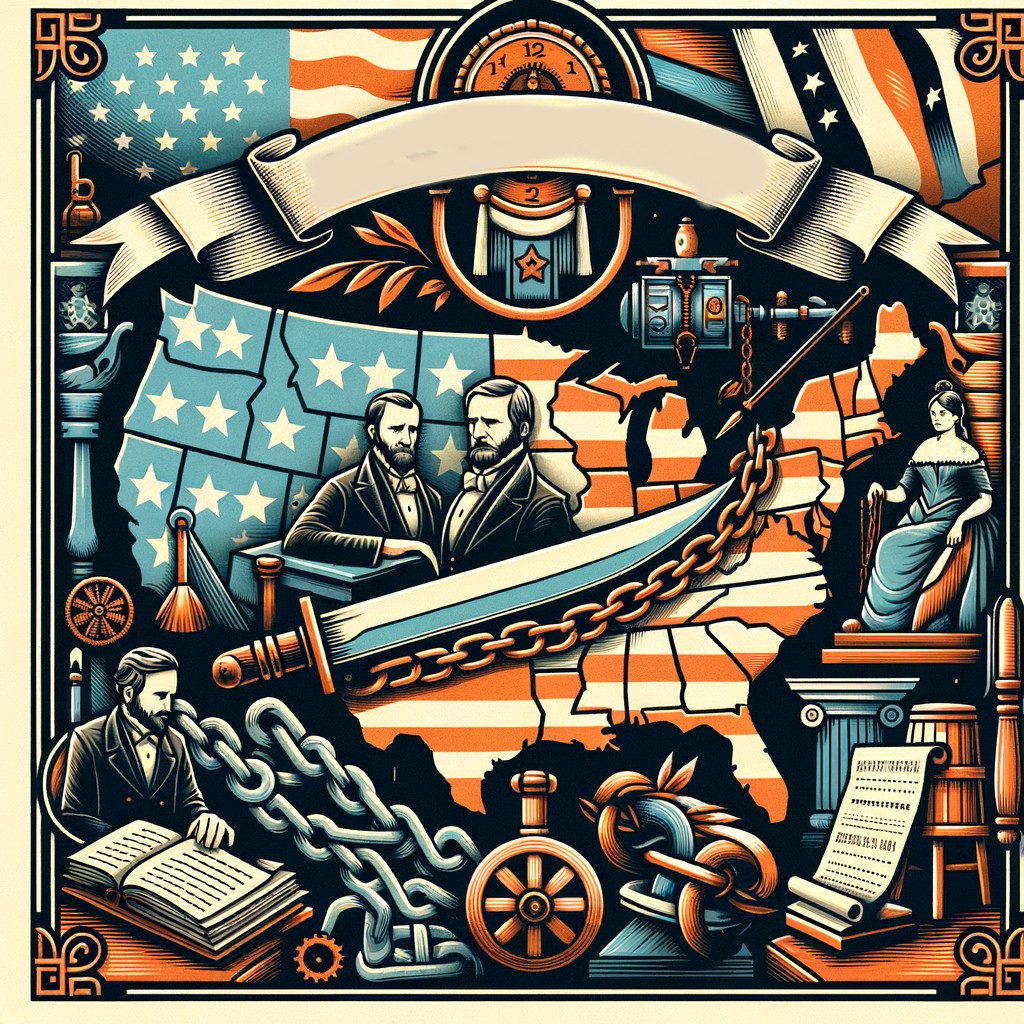
Mid-1800s American Sectionalism: Understanding the Divisions
Introduction
Sectionalism, a potent force in the mid-nineteenth century United States, refers to the profound divisions and hostilities between the Northern and Southern states, primarily over slavery and the power of the federal government. As the nation expanded, conflicting interests and values in the different regions exacerbated these divisions, eventually leading to the American Civil War. This paper explores the facets and impacts of sectionalism, shedding light on how it shaped America’s national identity and fostered an environment ripe for conflict.
The mid-1800s were a tumultuous period for the United States, characterized by rapid expansion and deepening fractures between the North and South. The economy, politics, and social fabric of these sections evolved distinctly, giving rise to a national crisis of identity and unity. Understanding sectionalism is crucial to comprehending the antebellum period’s complexities and the eventual onset of the Civil War.
Historical Context
The mid-1800s marked a pivotal era in American history, with the nation undergoing significant transformations. The United States, initially comprising thirteen colonies along the Atlantic coast, expanded westward, incorporating new territories and states. This expansion brought forth various challenges, as the newcomers needed integration into the existing political and economic structures. Furthermore, each new state’s stance on slavery became a contentious issue, further dividing the nation along sectional lines.
The Industrial Revolution played a pivotal role in deepening these divisions. While the North embraced industrialization, the South remained largely agrarian. The North developed an economy based on manufacturing and commerce, becoming urbanized and cosmopolitan. In contrast, the Southern economy relied heavily on plantation agriculture, necessitating a large labor force of enslaved individuals. These fundamental economic differences contributed to divergent social and cultural developments, with each section fostering distinct identities and ways of life.
Political developments during this period further exacerbated sectional tensions. The question of whether new territories would permit slavery was a constant source of conflict. Various legislative efforts sought to maintain a delicate balance between free and slave states, but these often provided only temporary solutions. The conflicting interests and values of the North and South set the stage for the political battles that would define the era, with sectionalism at the forefront of national discourse and policy.
Economic Sectionalism
The economic structures of the Northern and Southern states during the mid-1800s were inherently different, primarily due to their unique geographical and social characteristics. Economic sectionalism became a significant factor in driving a wedge between the two regions, further complicating their relationships and interactions.
Northern Economy
The Northern states experienced a substantial economic transformation during this period, largely due to the onset of the Industrial Revolution. The North began to focus extensively on industry and trade, fostering the development of factories, businesses, and financial institutions. This economic shift resulted in a greater demand for a diverse labor force, attracting a significant influx of immigrants, who contributed to the region’s rapid urbanization.
Infrastructure played a crucial role in the Northern economy, with significant investments in transportation, including canals, roads, and railroads. These developments facilitated the efficient movement of goods and people, enhancing trade and communication, thereby fostering economic growth and integration. The North’s economy became increasingly diverse and dynamic, laying the groundwork for a robust and resilient financial system.
Southern Economy
Contrastingly, the Southern states remained deeply entrenched in an agrarian economic system, relying heavily on plantation agriculture. The vast plantations produced lucrative cash crops such as cotton, tobacco, and sugar, which were heavily dependent on the labor of enslaved individuals. Slavery was not merely a social institution in the South; it was integral to the region’s economic vitality and stability.
The Southern economy was export-oriented, with the majority of its agricultural products shipped to European and Northern American markets. This reliance on exports made the South economically vulnerable and dependent on international trade dynamics. Furthermore, the Southern states lagged in industrial development and infrastructure investment, limiting economic diversification and leading to a highly specialized, agrarian financial system.
These stark economic differences between the North and South contributed significantly to sectional tensions. The regions developed contrasting economic interests and priorities, influencing their perspectives on various national issues, including taxation, trade policies, and slavery. As the United States navigated through the complexities of the mid-1800s, the chasm between the Northern and Southern economies widened, reinforcing the sectional divisions that characterized this historical period.
Political Sectionalism
Political sectionalism during the mid-1800s was primarily driven by the distinct economic structures and social ideologies of the North and South, leading to differing visions for the country’s future and governance structure.
Political Landscape
The political scene in the United States during this era was highly dynamic and contentious. The dominant political parties of the time, the Democrats and the Whigs, grappled with the growing tensions and conflicts arising from sectionalism. Each party had support in both the North and South, but internal divisions on key issues, especially slavery, strained party cohesion and effectiveness.
There were continuous debates regarding states’ rights versus federal authority, with Southern states often championing states’ rights as a means to preserve slavery and resist any federal attempt to regulate or abolish the institution. This battle over governance created a politically charged and unstable environment, often resulting in policy deadlocks and governmental inefficiencies.
Legislative Compromises
To address the rising tensions, several legislative compromises were enacted, aiming to maintain a delicate balance between slave and free states. The Missouri Compromise of 1820 was among the first significant legislative attempts to mitigate sectional conflicts, admitting Missouri as a slave state and Maine as a free state to preserve the Senate’s balance.
The Compromise of 1850, another crucial piece of legislation, included provisions designed to appease both sides of the sectional divide. It admitted California as a free state, established the territories of Utah and New Mexico with the possibility for residents to decide on slavery, and enacted a stricter Fugitive Slave Law. However, these compromises often provided temporary relief, failing to address the underlying issues fueling sectionalism.
The Kansas-Nebraska Act of 1854 further exacerbated tensions by allowing the residents of the Kansas and Nebraska territories to decide whether to permit slavery, effectively repealing the Missouri Compromise. This act led to violent conflicts, famously known as “Bleeding Kansas,” reflecting the deep and irreparable rifts within the nation.
Each of these legislative acts highlighted the profound challenges and conflicts brought about by sectionalism. The political landscape was fraught with division and contention, reflecting the disparate visions and interests of the North and South. These differences eventually culminated in the breakdown of national unity and the onset of the Civil War.
Social and Cultural Sectionalism
Social and cultural sectionalism mirrored the economic and political divisions of the mid-1800s United States, further entrenching the North-South divide. Each region developed distinctive social structures and cultural norms, significantly influencing their identities and worldviews.
Northern Society
The North underwent substantial social changes due to urbanization and industrialization. This transformation led to the emergence of a diverse and dynamic society, featuring various social reform movements. These movements included abolitionism, women’s suffrage, and temperance, reflecting the growing societal awareness and activism regarding civil rights and social justice.
The region also experienced significant immigration, resulting in a cultural melting pot. Immigrants, primarily from Europe, brought their traditions, values, and labor, contributing to the Northern states’ economic and cultural vibrancy. Education was highly valued, with many Northern states investing in public schooling and higher education institutions.
Religion played a crucial role in shaping Northern society, with various denominations and religious movements influencing social norms and values. The Second Great Awakening, a Protestant religious revival, had a profound impact, inspiring numerous social reform initiatives and shaping the region’s moral and ethical compass.
Southern Society
The Southern society was structured around plantation life, where the elite plantation owners, or the planter class, wielded significant economic and political power. This class dominated not only the agricultural sector but also the social and cultural life of the region, establishing a hierarchical and stratified society.
Enslaved individuals formed the labor backbone of Southern society, subjected to harsh conditions and denied basic rights. They developed a unique culture, blending African traditions with American influences, which significantly contributed to the American cultural tapestry.
Religion in the South often served to justify and perpetuate slavery, with many religious leaders and institutions supporting the institution as a divinely sanctioned practice. Education was not as accessible or widespread as in the North, with limited investment in public education and higher learning institutions, further entrenching social inequalities and limiting social mobility.
These social and cultural differences between the North and South significantly contributed to the sectional divide, as each region viewed the other with suspicion and misunderstanding. The social fabric of the United States was deeply influenced by these sectional differences, playing a pivotal role in the events leading up to the Civil War.
Sectionalism’s Impact on National Identity
The pervasive sectionalism of the mid-1800s not only deepened divides among states but also significantly impacted the formation and perception of American national identity. During this era, regional loyalties often superseded national ones, creating a disjointed and fractured sense of belonging and citizenship.
As the North and South continued to drift apart economically, politically, and culturally, regional identities strengthened. In the North, the identity was closely tied to industrial progress, economic opportunity, and social reform movements. Citizens often prided themselves on the region’s rapid modernization and commitment to social justice and equality. The prevailing Northern identity was one of progress, innovation, and moral righteousness, reflective of the societal changes and values emerging in the region.
The South, conversely, developed an identity deeply rooted in tradition, agriculture, and a hierarchical social structure. Southern identity was closely linked with the institution of slavery, as it was integral to the region’s economy and way of life. Southern society valued honor, chivalry, and loyalty, with a strong emphasis on preserving traditions and resisting external interference. This commitment to a distinctive way of life fostered a strong, almost defensive, regional pride among Southerners, further distancing them from their Northern counterparts.
The rise of these strong regional identities inevitably led to a diminishing sense of national unity. The conflicting values, interests, and visions for America’s future created an environment where compromise became increasingly difficult, and sectional interests took precedence over national ones. Events like the publication of Harriet Beecher Stowe’s “Uncle Tom’s Cabin” and the violent conflicts in “Bleeding Kansas” highlighted and exacerbated the growing divide, making reconciliation and understanding between the sections more elusive.
The intensification of sectionalism, coupled with the inability to find lasting political solutions, ultimately paved the way for the American Civil War. This tragic conflict was a manifestation of the deep-seated divisions and tensions that had been brewing for decades, reflecting the struggle not only for political and economic control but also for the soul and identity of the nation.
Conclusion
In conclusion, sectionalism during the mid-1800s was a powerful and divisive force that significantly shaped the United States’ trajectory. Economic, political, and social sectionalism converged to create an environment characterized by misunderstanding, conflict, and ultimately, disunion. The Northern and Southern states, driven by fundamentally different economic systems and social values, grew increasingly distant and antagonistic towards each other. These divisions were not merely geographic or economic; they represented a deep chasm in the understanding and envisioning of what America represented and should become.
The economic disparities between the industrial North and agrarian South set the stage for conflicting interests and priorities, further exacerbated by political battles over state and federal rights, and legislative compromises that only temporarily eased tensions. Social and cultural sectionalism mirrored and reinforced these divides, with each region developing distinctive identities and worldviews deeply influenced by their social structures and norms.
As sectional loyalties strengthened, the sense of a unified national identity weakened, culminating in the American Civil War. The war was not only a battle over territory or political power but a profound struggle for defining the nation’s soul and future direction. Understanding sectionalism is crucial for comprehending the complex, multifaceted nature of this historical period and the factors that led to one of the most significant conflicts in American history.
Frequently Asked Questions about mid 1800's Sectionalism
Economic sectionalism was a significant factor contributing to the North-South divide in the mid-1800s. The North underwent industrialization, shifting its economic focus towards manufacturing and trade. This transformation led to urbanization and the creation of a diverse labor market, including a significant influx of immigrants seeking employment opportunities. The economy in the North was dynamic, with various industries flourishing, leading to the development of a robust and diversified economic environment. In contrast, the Southern economy remained agrarian and heavily reliant on plantation agriculture. The cultivation of cash crops, such as cotton, required substantial labor, provided primarily by enslaved individuals. This economic dependency on slavery entrenched the institution in the Southern social fabric, creating a socio-economic system significantly different from that in the North. The disparity in economic structures and dependencies led to conflicting interests and visions between the two regions, ultimately contributing to the deepening divide and tensions leading up to the Civil War.
Several significant political compromises attempted to address the growing sectional tensions in the mid-1800s. The Missouri Compromise of 1820 was a pivotal legislative act designed to maintain the Senate balance between slave and free states. It admitted Missouri as a slave state and Maine as a free state, establishing a precedent for the admission of new states in pairs. Another crucial compromise was the Compromise of 1850, which included various provisions to appease both anti-slavery and pro-slavery factions. It admitted California as a free state, allowed the Utah and New Mexico territories to decide on slavery through popular sovereignty, and enacted a stricter Fugitive Slave Law. The Kansas-Nebraska Act of 1854 further complicated the situation by allowing these territories’ residents to decide on slavery, effectively nullifying the Missouri Compromise’s provisions. While these compromises aimed to quell sectional tensions temporarily, they failed to address the fundamental issues driving the divide, often exacerbating conflicts and pushing the nation closer to civil war.
The social and cultural differences between the North and the South played a crucial role in exacerbating sectional tensions. In the North, the societal landscape was shaped significantly by the forces of industrialization and urbanization. There was a marked emphasis on social reform movements, including abolitionism, women’s rights, and temperance. These movements reflected a growing consciousness regarding social justice and civil rights. The influx of immigrants contributed to the North’s cultural diversity, creating a mosaic of traditions and values that defined the region’s identity.
In contrast, the South’s social structure was deeply tied to plantation agriculture and slavery. The plantation class, owning vast tracts of land and large numbers of enslaved people, wielded significant economic and political power. Southern society was more hierarchical and conservative, with traditions and norms that sought to preserve the established social order. The institution of slavery was not just an economic necessity but also a social institution that significantly influenced Southern culture and identity.
These profound social and cultural differences led to mutual misunderstanding and distrust between the North and the South. Each side viewed the other through the lens of their societal norms and values, often leading to miscommunication and conflict.
Religion played a pivotal role in the sectionalism that characterized the mid-1800s. In the North, the Second Great Awakening spurred numerous social reform movements, including abolitionism. Many Northern religious groups and leaders denounced slavery as morally reprehensible, advocating for its immediate abolition. This religiously fueled anti-slavery sentiment significantly influenced the region’s politics and society, further aligning the North against the institution of slavery.
Conversely, in the South, many used religion as a tool to justify and perpetuate slavery. Various religious interpretations argued that slavery was divinely sanctioned, providing moral justification for its continuation. Some Southern religious leaders and denominations actively supported slavery, further embedding it into the region’s social and cultural fabric. The differing religious views on slavery contributed to the growing divide between the North and the South, as each side believed that they were morally justified in their stance, leaving little room for compromise.
- Literature and media had a profound impact on sectionalism during the mid-1800s, serving as influential tools in shaping public opinion and perception. Harriet Beecher Stowe’s “Uncle Tom’s Cabin” is a prime example. The novel, which depicted the harsh realities of slavery, garnered widespread acclaim in the North and ignited anti-slavery sentiments among readers. It humanized enslaved individuals, showcasing their struggles and humanity, and painted a damning picture of the institution of slavery. In the South, however, the novel was vehemently criticized and dismissed as abolitionist propaganda.
Newspapers and periodicals also played a crucial role. The North and the South had their own publications, which often presented biased and sectional perspectives on ongoing issues and events. These media outlets reinforced existing prejudices and views, further widening the gap between the two regions. Literature and media effectively crystallized and disseminated the conflicting values and identities of the North and the South, contributing to the deepening sectional divide.