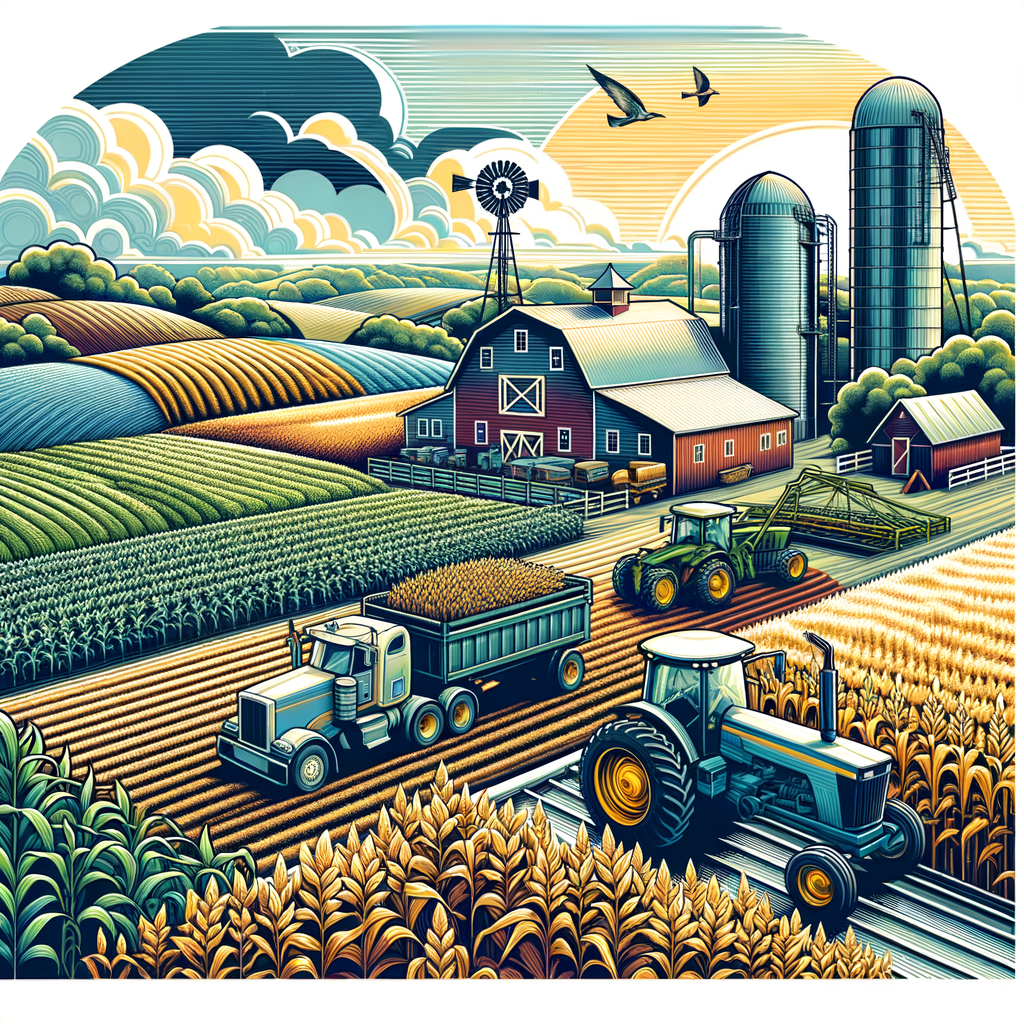
Agriculture in the United States
Agriculture has long been an indelible facet of the American identity. From the indigenous peoples who cultivated maize thousands of years ago to the sprawling farms of today’s Heartland, the relationship between the land and its inhabitants has always been symbiotic and formative. Agriculture’s role in the United States isn’t just historic or cultural; it’s foundational to the nation’s economic and social fabric. The sprawling amber waves of grain are not just symbols of poetic lore but represent real fields feeding millions. This essay aims to delve into the multifaceted world of U.S. agriculture, exploring its rich history, its economic and societal impact, and the challenges and innovations that define its modern era. As the global community faces pressing concerns related to food security, environmental sustainability, and economic equitability, understanding the state and trajectory of American agriculture becomes increasingly vital.
The Evolution of American Agriculture
The roots of American agriculture extend deep into the pre-colonial period. Indigenous tribes had a diverse range of agricultural practices tailored to the vast array of climates and landscapes across the continent. For instance, the “Three Sisters” planting of maize, beans, and squash showcased an understanding of ecological balance and sustainable farming.
However, the arrival of European settlers brought significant change. Colonial farming integrated European techniques with indigenous knowledge, leading to a unique blend of agricultural practices. The cultivation of crops like tobacco in Virginia and the Carolinas became economic pillars of these early colonies.
The 19th century heralded transformative innovations. Eli Whitney’s invention of the cotton gin in 1793 revolutionized Southern agriculture, solidifying cotton’s dominion and, unfortunately, intensifying the reliance on slave labor. Meanwhile, in the Midwest, the advent of mechanical reapers made grain harvesting more efficient, paving the way for the region to become the nation’s breadbasket. The expansion of railroads, concurrently, connected farms to urban centers and ports, facilitating trade and distribution, turning local farms into contributors to a national — and increasingly global — food system.
The 20th century brought further dramatic shifts. Mechanization reached new heights with the popularization of tractors and combines, which increased yields but also began the trend of reducing the labor force in agriculture. The introduction of chemical fertilizers and pesticides promised bountiful crops, but these advancements also introduced new environmental challenges, some of which we grapple with today.
Parallel to these developments was the rise of agribusiness. As farms grew and consolidated, corporate entities began to wield significant power in the agricultural sector. This shift had profound implications, from changing the economic dynamics of farming to influencing agricultural policies at the national level.
From its earliest days to the modern era, the story of American agriculture is one of innovation, adaptation, and transformation. As we move forward, it’s crucial to understand this history, not only to appreciate where we’ve been but to inform where we’re going.
Major Agricultural Regions and Products
The diverse landscapes and climates of the United States have given rise to several distinct agricultural regions, each with its own signature crops and farming practices.
The Corn Belt, spanning states such as Iowa, Illinois, and Nebraska, stands as the epicenter of corn production. As the world’s leading producer of corn, this region not only supplies food products but also provides feed for livestock and raw material for ethanol production. The vast fields, while synonymous with American abundance, also raise concerns about monoculture and its ecological implications.
The Wheat Belt, primarily located in the Great Plains, including states like Kansas, Oklahoma, and North Dakota, is instrumental in producing wheat for both domestic consumption and export. Different types of wheat, like hard red winter wheat, are cultivated in this region. However, the vast monocultures here too have raised sustainability concerns, especially in relation to water use and soil health.
Further north lies the Dairy Belt, encompassing Wisconsin, Minnesota, and parts of Michigan. Known as “America’s Dairyland,” this region is a hub for milk and cheese production. The rise of factory farming in the dairy industry here has garnered attention due to its environmental footprint and concerns about animal welfare.
States like California and Florida, on the other hand, are known for their specialty crops. California, with its Mediterranean climate, produces a staggering array of fruits, vegetables, and nuts, from almonds to zucchinis. It’s also the leading wine-producing state in the U.S. Florida, famous for its citrus fruits, especially oranges, faces challenges like citrus greening disease that threatens its iconic groves.
Lastly, livestock and ranching have strongholds in states like Texas, Oklahoma, and Montana. The vast ranches in these regions contribute significantly to beef production, while simultaneously engaging in debates about land use, grazing rights, and methane emissions.
Modern Challenges and Issues in US Agriculture
As American agriculture has evolved, it has encountered a range of challenges, many exacerbated by modern practices and global pressures.
Environmental Concerns:
Top among these is the environmental toll. Soil erosion, a consequence of tilling and monocultures, strips land of its productive capacity. Over-reliance on chemical fertilizers and pesticides has led to runoff that contaminates water sources, creating “dead zones” in water bodies. Additionally, the draining of aquifers, especially in regions like California’s Central Valley, raises alarms about the long-term availability of water.
Economic Pressures:
The modern agricultural landscape is characterized by a dichotomy of large-scale commercial farms and smaller family-run farms. While agribusinesses have the capital to invest in technology and weather market fluctuations, small farmers often struggle with debt, price volatility, and land access. Global trade dynamics, such as the U.S.-China trade tensions, further exacerbate these economic pressures, making certain markets unpredictable.
Labor and Immigration:
The agricultural sector relies heavily on labor, often from migrant workers. These workers, integral to planting, cultivating, and harvesting, face issues ranging from low wages to challenging working conditions. The evolving landscape of immigration policies adds a layer of uncertainty to this already precarious situation.
Technological Advancements and Bioengineering:
The introduction of genetically modified organisms (GMOs) aimed to improve yield and pest resistance. While they have achieved some of these goals, they have also sparked debates about biodiversity, health implications, and corporate control over seeds. Advances in AI and precision agriculture promise optimized farming but also raise questions about data privacy and job displacement.
Climate Change:
Perhaps the most pressing challenge, climate change threatens to disrupt growing seasons, introduce new pests, and exacerbate water scarcity. Events like droughts, floods, and unpredictable weather patterns pose significant risks to a sector inherently dependent on the rhythms of nature.
In navigating these challenges, American agriculture stands at a crossroads, balancing the promise of innovation with the imperative of sustainability. As we move deeper into the 21st century, the choices made will have ramifications not just for the U.S. but for global food systems at large.
Recent Changes in Agriculture
The history of agriculture in the U.S. since the Great Depression has been one of consolidation and increasing efficiency. From a high of 6.8 million farms in 1935, the total number declined to 2.1 million in 1991 on a little less than the same area, about 397 million hectares (about 982 million acres). Average farm size in 1935 was about 63 hectares (about 155 acres); in 1991 it was about 189 hectares (about 467 acres).
About 4.6 million people lived on farms in 1990, based on a new farm definition introduced in 1977 to distinguish between rural residents and people who earned $1000 or more from annual agricultural product sales. The farm population continues to constitute a declining share of the nation’s total; about I person in every 54, or 1.8 percent, of the nation’s 250 million people were farm residents in 1990.
Total value of land and buildings on U.S. farms in 1990 was $658 billion, substantially less than the value in 1980. Value of products sold was $170 billion per year. Overall net farm income was more than $46 billion in 1989, of which government subsidies accounted for 23 percent. Not including real estate, major expenditures by farmers in 1989 were for feed ($22.7 billion); fuel, lubricants, and maintenance ($13.1 billion); hired labor ($11.9 billion); fertilizer ($7.6 billion); and seed ($3.7 billion).
Outstanding farm debt in 1989 was $146 billion, of which about 55 percent was owed on real estate. Interest payments on the mortgage debt were about $7.6 billion per year. In 1980 a report based on projections by the U.S. government stated that in the next 20 years world food requirements would increase tremendously, with developed countries requiring most of the increase, and food prices would double. Less than five years later, however, the U.S. farmer was enveloped in a major crisis caused by exceptionally heavy farm debts, mounting farm subsidy costs, and rising surpluses. A number of farmers were forced into foreclosure. The ailing Farm Credit System, a group of 37 farmer-owned banks under the Farm Credit Administration appealed to the government for a $5 to $6 billion fund that would keep the system solvent despite the weak national farm economy. After initial resistance, President Ronald Reagan signed legislation in December 1985 designed to create the Farm Credit System Capital Corporation to take over bad loans from the system’s banks and to assume responsibility for foreclosing or restructuring distressed loans.
In December President Reagan also signed the Food Security Act of 1985, legislation designed to govern the nation’s farm policies for the next five years, trim farm subsidies, and stimulate farm exports.
Government Price-Support Policies
One of the recurring problems of American agriculture in the 20th century has been the tendency of farm income to lag behind increases in the costs of production. The problem began in the 1920s, following a period of exceptional prosperity for U.S. farmers. The period 1910-14 was later taken as a standard for the level of farm prices in relation to the general price level and formed the basis for a concept called parity, aimed at maintaining farming as an essential part of the U.S. economy. After the outbreak of World War I the U.S. became the chief source of food for the
warring nations of Europe, with U.S. farmers bringing some 16 million additional hectares (about 40 million acres) of land under cultivation and investing heavily in new land and equipment. These measures raised production levels until 1920, when the European demand for U.S. farm products suddenly declined, and prices began a continuing downward spiral. Although attempts were under way to ease the economic difficulties of the farmer, farm income had not begun to recover when the Great Depression of the 1930s intensified them even more. By 1932 the level of farm prices was only about 65 percent of the 1910-14 average. Farmers continued to produce almost as much as before, and even increased their production in an attempt to maintain their income. That succeeded only in lowering farm prices further. By
comparison, manufacturers could control their production, thereby maintaining price levels to a certain degree. Although prices for industrial goods declined, they did not drop as severely as farm prices, so that by 1932 farmers were receiving only 58 cents from the sale of their products for every dollar they had to pay for non-farm
items.
The federal government, which had done little in the 1920s to help farmers, initiated remedial programs during the administration of President Franklin D. Roosevelt. One approach was to reduce the supply of basic farm commodities. The Agricultural Adjustment Act of 193 3 provided payments to farmers in return for agreements to curtail their acreage or their production of wheat, cotton, rice, tobacco, corn hogs, and dairy products. The act was declared unconstitutional in 1936, but in 1938, after several changes in the membership of the U.S. Supreme Court, a second Agricultural Adjustment Act was passed under which production quotas were set as before. Payments were financed from taxes imposed on processors and were based on the parity concept.
The government also lent money to farmers to enable them to withhold crops from the market when prices were low and to store the produce so that it might be available in poor crop years.
A third method to limit production provided payments for shifting acreage of soil depleting crops such as corn, wheat, cotton, tobacco, and rice to soil-conserving plants such as grasses and legumes and for carrying out soil-building practices. In 1939, an all-risk crop insurance program was initiated for interested
farmers to prevent economic distress in case of crop failure for hail, floods, and other natural disasters. Until World War 11 the problem of low farm prices was not basically a result of overproduction. Rather, it was a consequence of the cycles of business and weather, and of problems of internal distribution, transportation, and credit. Following World War II, however, overproduction became a serious problem. Both during and immediately after the war, farm prices were generally high. Because production costs also were high, parity payments remained in force. Federal
transactions in surplus commodities, principally the sale of such commodities at prices less than those paid to farmers, proved costly for the government. To reduce costs of the federal farm program, the administration of President Dwight D. Eisenhower proposed the substitution of flexible or variable price supports for the rigid 90 percent of parity that was in force. A bill authorizing a sliding scale of payments at 82.5 percent to 90 percent of parity on the basic commodities was enacted by the U.S. Congress in 1954.
The Agricultural Act of 1956, otherwise known as the soil-bank program, authorized federal payments to farmers if they reduced production of certain crops. A subsidy plan was formulated whereby farmers would be paid for converting part of their cropland to soil-conserving, uses. In practice, the farmers shared the costs of planting trees or grasses and received annual payments compensating them for the economic loss incurred by the removal of some of their land from production.
The Department of Agriculture in the administrations of Presidents John Kennedy and Lyndon Johnson during the 1960s made control of overproduction a primary goal of farm policy. Farmers were offered what was in effect a rental payment for a part of their land that would be taken out of production during the following year. At the same time, measures were undertaken to expand the export market for agricultural products. During this period the ratio of a farmer’s per capita income to that of a non-farm person increased from about 50 percent to about 75 percent.
Direct subsidies for withholding agricultural land from production were phased out in 1973, as a result of a proposal by President Richard M. Nixon. In the same year, net farm income swelled to $33.3 billion. Poor grain harvests throughout the world, particularly in the Soviet Union, prompted massive sales of U.S. government-owned
grain reserves. World climatic conditions also helped keep demand for U.S. produce high through the mid- I 1970’s Toward the end of the decade, exports lessened, prices dropped, and farm income began to fall without a corresponding decrease in costs of production. U.S. net
farm income in 1976 fell to $18.7
billion.
In 1978, a limited, voluntary output restriction was begun by President Jimmy Carter. Called the “farmer-held grain reserve program,” the action took grains off the market for up to three years or until market prices reached stated levels. The program was intended also to provide an adequate reserve, lessen food-price gyrations and combat inflation, give livestock
producers protection from extremes in feed costs, and contribute to greater continuity in foreign food aid. On January
4, 1980, President Carter declared a limited suspension of grain sales to the Soviet Union in response to that country’s invasion of Afghanistan, Additional restrictions included a prohibition on sales of U.S. phosphate. Despite the grain embargo, the U.S. continued to honor a 5 year agreement already in effect that committed it to sell 8 million tons of grain to the Soviets yearly. The year 1980 was an election year, and despite efforts by President Carter’s opposition to void the embargo, it continued. Administration officials argued that the Soviets had never been a major customer or even a reliable buyer. U.S. farmers maintained, however, that the action was at their expense and had made 1980 one of their worst years. In fact, U.S. farm exports in 1980 reached an all time high of $40 billion, but the continued rise in costs of production and an extremely hot summer with accompanying droughts affected many farmers adversely. A new crop insurance program, passed by Congress in the fall of 1980, offered relief from such conditions rather than having to rely on disaster loans, which amounted to $30 million for feed alone in that year.
Whether the 1980 grain embargo had a strong effect on the USSR was a matter of conjecture. Beef production dropped 16 percent, pork was off 10 percent, and milk production fell 4 percent, but by the end of the year the Soviets had apparently obtained their needed grain from other sources. When President Ronald Reagan took office in 1981, he lifted the embargo and extended the agreement that allowed the USSR to purchase 8 million tons of grain yearly from the U S. The two nations then signed a new 5 Year agreement in 1983 that obliged the Soviet Union to import a minimum of 9 million
tons of U.S. grain every year.
Agricultural Exports
The U.S. is the world’s principal exporter of agricultural products. In 1989 the value of produce exported was about $39.7 billion, including roughly $1.5 billion in donations and loans to developing nations.
A substantial percentage of the wheat, soybeans, rice, cotton, tobacco, and corn for grain produced in the U.S. Is exported.
The major foreign markets are Asia, Western Europe, and Latin America. Japan heads the list of individual countries that import U.S. farm products.
Recent Impacts on Agriculture in the United States – 1990 – 2023
Agriculture in the United States has undergone significant changes in the past three decades. Technological advancements, globalization, and climate change have all had a major impact on the industry.
One of the most significant trends in US agriculture has been the increasing concentration of farms and production. In 1990, the top 1% of farms accounted for 13% of agricultural output. By 2023, that share had grown to 25%. This concentration has been driven by a number of factors, including the economies of scale associated with large-scale farming and the availability of government subsidies.
Another major trend has been the globalization of agriculture. The United States is now both a major exporter and importer of agricultural products. In 1990, agricultural exports accounted for 10% of total US exports. By 2023, that share had grown to 20%. The United States is also a major importer of agricultural products, particularly fruits, vegetables, and processed foods.
Climate change has also had a significant impact on US agriculture. Rising temperatures, more extreme weather events, and changes in precipitation patterns have all made it more difficult for farmers to produce crops and raise livestock.
Despite these challenges, US agriculture remains a major economic force. In 2023, the agricultural sector accounted for 5% of US GDP and employed over 2 million people. The United States is also the world’s leading producer of corn, soybeans, wheat, and cotton.
Here is a more detailed look at some of the key trends in US agriculture from 1990 through 2023:
Technological advancements
Technology has played a major role in transforming US agriculture in recent decades. Farmers now have access to a wide range of advanced technologies, including precision agriculture tools, GPS-guided equipment, and biotechnology. These technologies have helped farmers to increase their productivity and efficiency, while also reducing their environmental impact.
For example, precision agriculture tools allow farmers to apply pesticides and fertilizers more precisely, which can help to reduce runoff and pollution. GPS-guided equipment helps farmers to plant and harvest crops more efficiently, which can save time and money. And biotechnology has led to the development of new crop varieties that are resistant to pests and diseases, which can help to reduce farmers’ reliance on pesticides.
Globalization
Globalization has also had a major impact on US agriculture. The United States is now both a major exporter and importer of agricultural products. This trade has benefited both US farmers and consumers.
US farmers have benefited from the ability to sell their products to overseas markets. This has helped to increase demand for US agricultural products and boost farm prices. US consumers have benefited from the lower prices of imported agricultural products.
However, globalization has also posed some challenges for US agriculture. For example, US farmers have faced competition from farmers in other countries with lower production costs. And US consumers have been exposed to food safety risks associated with imported agricultural products.
Climate change
Climate change is another major challenge facing US agriculture. Rising temperatures, more extreme weather events, and changes in precipitation patterns are all making it more difficult for farmers to produce crops and raise livestock.
For example, rising temperatures are making it more difficult to grow crops in some parts of the country. More extreme weather events, such as droughts and floods, are also damaging crops and livestock. And changes in precipitation patterns are disrupting traditional growing seasons.
US farmers are working to adapt to the challenges of climate change. They are adopting new farming practices, such as using drought-tolerant crops and planting cover crops to improve soil health. They are also investing in new technologies, such as irrigation systems that are more efficient in using water.
Conclusion
US agriculture has undergone significant changes in the past three decades. Technological advancements, globalization, and climate change have all had a major impact on the industry. Despite these challenges, US agriculture remains a major economic force. The United States is also the world’s leading producer of corn, soybeans, wheat, and cotton.
In the coming years, US agriculture is likely to continue to evolve. Farmers will need to continue to adapt to the challenges of climate change and globalization. They will also need to invest in new technologies and farming practices in order to meet the growing demand for food.
History – US Secretary of Agriculture from 1961 to 2023
Orville Freeman (1961-1969)
Freeman was a Minnesota Democrat who served as Secretary of Agriculture under Presidents Kennedy and Johnson. He was a strong advocate for civil rights and social justice in agriculture. He also oversaw the expansion of the Food Stamp Program and the creation of the Rural Electrification Administration.
Clifford Hardin (1969-1971)
Hardin was a Kansas Republican who served as Secretary of Agriculture under President Nixon. He was a strong advocate for free trade and supported the Nixon administration’s policies of deregulation and tax cuts. He also oversaw the creation of the Environmental Protection Agency.
Earl Butz (1971-1976)
Butz was an Indiana Republican who served as Secretary of Agriculture under President Nixon. He was a strong advocate for increased agricultural production and supported the Nixon administration’s policies of deregulation and tax cuts. He also oversaw the creation of the Export-Import Bank.
Bob Bergland (1977-1981)
Bergland was a Minnesota Democrat who served as Secretary of Agriculture under President Carter. He was a strong advocate for family farms and supported the Carter administration’s policies of price supports and farm subsidies. He also oversaw the creation of the Farm Credit System.
John Block (1981-1985)
Block was an Illinois Republican who served as Secretary of Agriculture under President Reagan. He was a strong advocate for free trade and supported the Reagan administration’s policies of deregulation and tax cuts. He also oversaw the creation of the Agricultural Productivity Act.
Richard Lyng (1985-1989)
Lyng was a California Republican who served as Secretary of Agriculture under President Reagan. He was a strong advocate for increased agricultural exports and supported the Reagan administration’s policies of free trade and deregulation. He also oversaw the creation of the Omnibus Farm Bill.
Clayton Yeutter (1989-1991)
Yeutter was a Nebraska Republican who served as Secretary of Agriculture under President George H.W. Bush. He was a strong advocate for free trade and supported the Bush administration’s policies of deregulation and tax cuts. He also oversaw the creation of the North American Free Trade Agreement (NAFTA).
Edward Madigan (1991-1993)
Madigan was an Illinois Republican who served as Secretary of Agriculture under President George H.W. Bush. He was a strong advocate for family farms and supported the Bush administration’s policies of price supports and farm subsidies. He also oversaw the creation of the Freedom to Farm Act.
Mike Espy (1993-1994)
Espy was a Mississippi Democrat who served as Secretary of Agriculture under President Clinton. He was the first African American to hold the position. He was a strong advocate for civil rights and social justice in agriculture. He also oversaw the implementation of the Freedom to Farm Act.
Dan Glickman (1995-2001)
Glickman was a Kansas Democrat who served as Secretary of Agriculture under President Clinton. He was a strong advocate for family farms and supported the Clinton administration’s policies of price supports and farm subsidies. He also oversaw the implementation of the Food Quality Protection Act.
Ann Veneman (2001-2005)
Veneman was a California Republican who served as Secretary of Agriculture under President George W. Bush. She was the first woman to hold the position. She was a strong advocate for free trade and supported the Bush administration’s policies of deregulation and tax cuts. She also oversaw the implementation of the No Child Left Behind Act.
Mike Johanns (2005-2007)
Johanns was a Nebraska Republican who served as Secretary of Agriculture under President George W. Bush. He was a strong advocate for family farms and supported the Bush administration’s policies of price supports and farm subsidies. He also oversaw the implementation of the Farm Security and Rural Investment Act of 2002.
Ed Schafer (2008)
Schafer was a North Dakota Republican who served as Secretary of Agriculture under President George W. Bush. He was a strong advocate for biofuels and supported the Bush administration’s policies of promoting renewable energy. He also oversaw the implementation of the Food, Conservation, and Energy Act of 2008.
Tom Vilsack (2009-2017)
Vilsack was an Iowa Democrat who served as Secretary of Agriculture under President Obama. He was a strong advocate for family farms and supported the Obama administration’s policies of price supports and farm subsidies. He was a strong advocate for family farms and supported the Obama administration’s policies of price supports and farm subsidies. He also oversaw the implementation of the Healthy, Hunger-Free Kids Act of 2010.
Sonny Perdue (2017-2021)
Perdue was a Georgia Republican who served as Secretary of Agriculture under President Trump. He was a strong advocate for free trade and supported the Trump administration’s policies of deregulation and tax cuts. He also oversaw the implementation of the United States-Mexico-Canada Agreement (USMCA).
Tom Vilsack (2021-present)
Vilsack was an Iowa Democrat who served as Secretary of Agriculture under President Biden. He previously served in the role from 2009 to 2017 during the Obama administration. A member of the Democratic Party, he served as the 40th governor of Iowa from 1999 to 2007.
Vilsack’s priorities as Secretary of Agriculture include:
- Combating climate change
- Supporting small and medium-sized farms
- Expanding access to healthy food
- Investing in rural communities
Vilsack has also been a vocal critic of the Trump administration’s trade policies, which he argues have hurt American farmers.
Conclusion
The Secretaries of Agriculture for the United States over the last 60 years have come from a variety of backgrounds and have had different priorities. However, they have all shared a commitment to supporting American farmers and ensuring that Americans have access to safe and affordable food.
The current Secretary of Agriculture, Tom Vilsack, is a strong advocate for family farms and is committed to combating climate change. He is also working to expand access to healthy food and invest in rural communities.